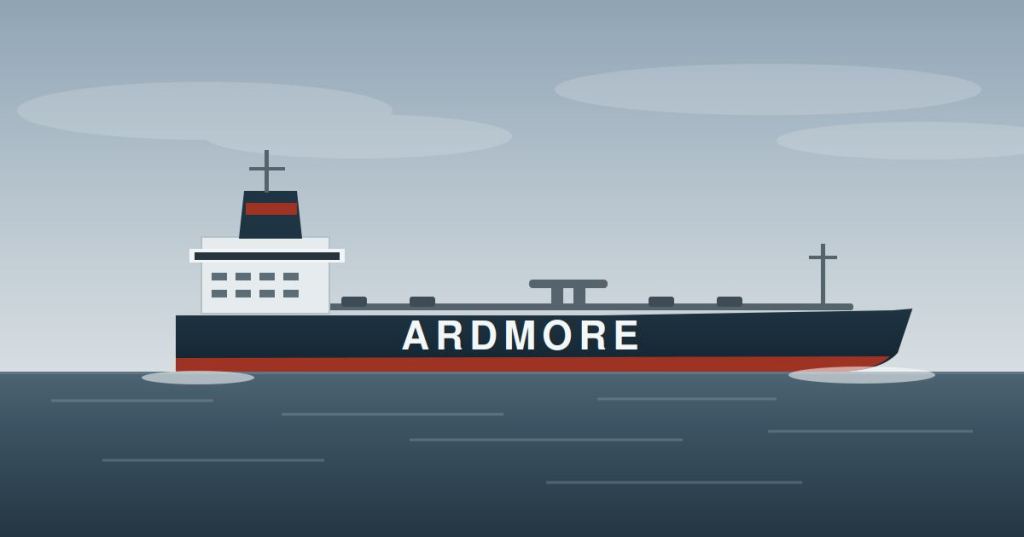
My August pick: 93 shares at $16.13. Now I wait for $22.6 — +40%… and for my money back.
The trade
| Date | August 2026 |
| Action | Buy |
| Stock | Ardmore Shipping Corporation (NYSE: ASC) |
| Shares | 92.96653 |
| Price | $16.13484 |
| Total | $1,500.00 |
| Strategy | Up 40% Free Stock Strategy |
| Target | $22.59 |
| Then | 10% trailing stop on 66.40 shares → capital back, 26.56 free shares kept forever |
The post
There is a certain kind of company that Wall Street treats the way respectable families once treated a rich uncle who made his money in trade: the dividends are welcome, the name is not mentioned at dinner. Shipping is that uncle. And this month I have invited him in.
I bought 92.96653 shares of Ardmore Shipping at $16.13484. One thousand five hundred dollars — my usual monthly ration, no more and no less, because a strategy that bends to enthusiasm is not a strategy, it is a mood.
Let me tell you why, and then let me tell you why I may be wrong, which is the part most stock bloggers forget to write.
What I am buying for $16
A share of Ardmore is a share of twenty-five owned tankers — nineteen MRs and six IMO 2 chemical carriers, a little over 1.1 million deadweight tonnes, average age 11.3 years. Middle-aged ships, in other words: past the expensive youth, well short of the scrapyard.
The whole company is priced at roughly $660 million. In June, Ardmore sold one single 2014-built MR, the Ardmore Engineer, for $35.5 million, booking a $12.2 million gain on the sale. I invite you to do the arithmetic yourself, slowly, and then to look again at the market capitalisation. I am not claiming the fleet would fetch that price twenty-five times over in a hurry — a forced seller never gets the last dollar. I am claiming that the market is valuing these ships at a good deal less than a willing buyer just paid for one of them.
Now the numbers everybody screens on:
- Trailing P/E 6.77. Forward P/E 3.39. The market is saying, in the only language it speaks, that it does not believe the second number.
- Quarterly revenue growth 61.3% year on year.
- Cash $48.1 million against total debt $33.4 million. A shipping company in a net cash position. Total debt fell from $127.0 million at the end of 2025. This is not a leveraged bet on freight rates; the leverage has already been paid off with the freight rates.
- First-half net income to common: $84.1 million, up 476%.
- Liquidity of $342.1 million, including $294 million of undrawn revolving credit.
The number that actually matters
Forget the multiples for a moment. The only figure I would keep if I had to throw away all the others is this one: Ardmore’s operating cash breakeven is about $10,800 per day.
In the second quarter, its MR tankers earned $51,870 per day. Its chemical tankers earned $26,887. Fleet-wide, $38,073.
That is the whole thesis in one line. Every $10,000 per day of extra rate is worth roughly $1.90 of annual earnings per share — on a $16 stock. Operating leverage of that violence cuts both ways, and I will come to the other way shortly. But a company that covers its costs at eleven thousand dollars a day, in a market paying thirty-eight, is not a company in trouble. It is a company printing money and slightly embarrassed about it.
A correction, since I do not like publishing stale figures
The screeners still show ASC with an annual dividend rate of $1.37 and a yield of 8.33%. That was true once. It is not true now.
On 29 July, under the new policy of paying out two-thirds of adjusted earnings, the board declared $0.79 per share for the second quarter alone — the fifteenth consecutive quarterly dividend. Management put the annualised yield at around 20%.
On my 92.96653 shares, that single quarter is worth about $73. If the next four quarters looked like the last one — they will not, and I will explain why — the position would pay back roughly $294 a year on a $1,500 investment.
I do not expect that. I expect the dividend to fall, because it is designed to fall: a variable payout tied to earnings is honest precisely because it does not pretend. But I would rather hold a company that hands me two-thirds of a good quarter and then two-thirds of a bad one, than one that borrows to keep a fixed dividend intact for the sake of the chart in the annual report.
Why it is cheap: the case against me
Here is where I part company with the gurus, who discover risks only after the stock has fallen.
First, the cycle. Tanker markets are violent by nature. When rates rise, owners drown in cash; the market knows the boom is temporary and refuses to capitalise it. A low multiple on peak earnings is not a bargain — it is the market’s way of saying these earnings are not real yet. This is not stupidity. It is memory.
Second, the war premium. Those $50,000-a-day MR rates were not conjured by good seamanship. They were manufactured by the Middle East: disrupted flows, closed or risky passages, cargoes taking the long way round. Ton-miles, not tons, set the price. If the Strait of Hormuz and the Red Sea return to normal traffic tomorrow, voyages shorten, effective vessel supply jumps, and the rates go down the drain in weeks. The discount on ASC is the price of that insurance policy, sold by shareholders to the market.
I want to be blunt about this, because it is uncomfortable: I am buying an asset whose current earnings are partly a function of other people’s misery. I would rather the war ended and my trade failed. Anyone who writes about tanker stocks without saying that is either dishonest or has not thought about it.
Third, the newbuildings. Ardmore has ordered four 40,500 dwt Handysize product/chemical tankers at Wuhu, $44.9 million apiece, with about $165 million of instalments still to pay through 2029 and two further options. Deliveries begin late 2028. The bear reads this as ordering steel at the top of the market with money earned at the top of the market, to be delivered when the top is a memory.
Fourth, the long goodbye. Refined-product demand faces the energy transition, export restrictions, and a general suspicion that oil’s best decades are behind it. Institutions will not pay a technology multiple for a business with a secular question mark over it — and they are not wrong to refuse.
My answers, such as they are
To the cycle: yes — which is exactly why I am not buying this for the grandchildren. I am buying it for 40%, and then I am taking my money out. The Up 40% strategy exists precisely for stocks I would not marry.
To the war premium: partly conceded. But the structural piece is not war. The Handysize orderbook stands at around 5% of the existing fleet against an average vessel age of 18 years; MR and chemical tankers together account for roughly 56% of the world tanker fleet by count. Refining capacity keeps moving further from where the fuel is burned, which lengthens voyages whether or not anyone is shooting. Peace would hurt. Peace would not, by itself, take rates to breakeven.
To the newbuildings: they are being funded from cash and an undrawn revolver, not from new leverage, by a company with no net debt and a $10,800 breakeven. That is a very different proposition from the same order placed by an owner at four times debt-to-EBITDA. If the market turns before 2028, Ardmore will be uncomfortable. It will not be insolvent.
To the energy transition: true, and irrelevant to a trade with a twelve-to-eighteen month horizon. The tankers will not be unemployed by Christmas. I am renting the cycle, not buying the century.
And the honest warning sign, already visible: third-quarter bookings are running at roughly $29,600 per day for MRs on about 45% of revenue days fixed. Still nearly three times breakeven — and well below the second quarter. The normalisation the bears predicted has already begun. Whether it stops at “very good” or continues to “ordinary” is the entire question, and I do not know the answer. Neither, dear reader, does the man selling you a newsletter that says he does.
The exit, decided now and not later
Rules written in the cold are worth ten times rules written in the heat.
- Trigger: $22.588 per share (+40% on $16.13484).
- Then: a 10% trailing stop on 66.40 shares, which at that price returns my $1,500.
- What remains: 26.56 free shares of Ardmore Shipping, mine, unpaid for, kept forever — collecting whatever dividends a variable policy chooses to send me for the rest of my life.
- If it goes down instead: I hold. I do not average down on a cyclical at the top of its cycle. That is not conviction, it is arithmetic.
Twenty-six free shares of a tanker company is not a fortune. But the proletarian investor does not seize the means of production in a single afternoon. He acquires them one ship at a time, quietly, and lets someone else pay.
Full disclosure: I own 92.96653 shares of ASC, bought at $16.13484. Nobody paid me to write this.
The usual and entirely sincere disclaimer applies: this is a diary, not advice. I am a small investor with a blog, not a financial adviser. Tanker stocks can halve as briskly as they double, and the war that made this trade interesting could end — and should end — before my trailing stop is ever placed.


Leave a Reply