| Action | Date | Price | Shares Quantity | Total |
|---|---|---|---|---|
| Buy | 04/19/2024 | $12.36 | 8 | $ 98.85 |
| Sell | 03/16/2026 | $23.22 | – 5 | $ 116.09 |
| Result | FREE SHARES | + 3 | + $ 17.24 |
One of the core ideas behind the Double-Up Free Stock Strategy is beautifully simple:
- Buy a small position in a solid company.
- Wait patiently.
- When the stock roughly doubles, sell enough shares to recover your original investment.
- Keep the rest forever — now they are free shares.
No leverage.
No day-trading.
No “this time it’s different” narratives.
Just discipline and patience.
The Trade
April 19, 2024 — Entry
Bought:
8 shares of Fastly Inc.
Price: $12.3568
Total investment: $98.85
At that time Fastly was a beaten-down cloud infrastructure company that had collapsed from its pandemic highs. Expectations were low, sentiment was worse, and the stock was largely ignored.
Which is often when interesting opportunities appear.
March 16, 2026 — Partial Exit
Sold:
5 shares of FSLY
Price: $23.22
Total received: $116.09
The Result
Let’s do the math.
Initial investment:
–$98.85
Cash received from sale:
+$116.09
Realized profit:
$17.24
And the best part:
I still own 3 shares of Fastly.
At around $23 per share, those shares are worth roughly $70 — with zero capital at risk.
Thanks to commission-free trading at Firstrade, there were no trading fees reducing the result.
So the final outcome is simple:
• Initial capital recovered
• $17 profit already locked in
• 3 shares completely free
Peanuts? Absolutely.
But free peanuts taste better.
What Fastly Actually Does
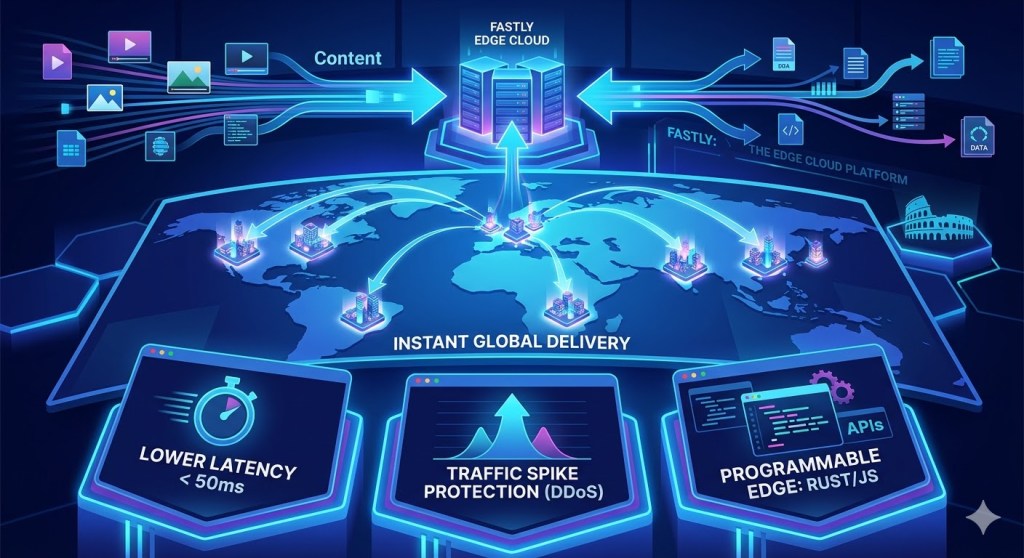
Fastly operates an edge cloud platform.
Traditional cloud infrastructure works like this:
User → Internet → Central data center → Response.
Fastly’s model moves computing closer to the user by distributing servers around the network.
That allows companies to:
• deliver content faster
• reduce latency
• process data closer to where it is generated
• improve real-time applications
Fastly powers parts of the internet used by:
• streaming platforms
• online retailers
• media companies
• software developers
If the internet were a road network, traditional clouds would be giant centralized highways.
Fastly builds local express lanes near the destination.
Why the Company Looked Interesting in 2024
Fastly had experienced one of the classic tech-stock boom-and-bust cycles.
During the pandemic:
• internet traffic exploded
• growth expectations soared
• the stock surged
Afterward:
• growth slowed
• sentiment reversed
• the stock collapsed
By 2024 the valuation had fallen dramatically compared with its previous highs.
Revenue growth continued, but expectations had reset to far more realistic levels.
This combination — useful technology but depressed sentiment — often creates good entry points.
The AI Infrastructure Angle
Fastly is not an “AI company” in the traditional sense.
But the AI boom indirectly increases demand for the infrastructure Fastly provides.
AI systems generate enormous amounts of data and require:
• fast networks
• low latency
• distributed computing
• real-time data delivery
Many AI-driven applications — recommendation engines, personalized content, real-time analytics — rely on edge computing.
That means companies building the infrastructure of the internet can benefit from the broader AI ecosystem.
Valuation in 2024
In 2024 Fastly was still in a growth phase, meaning traditional metrics like P/E ratio were not always meaningful because profitability was still evolving.
However other valuation metrics had become far more attractive:
Price-to-sales had compressed significantly compared with the speculative valuations seen during the pandemic tech boom.
Investors had gone from overly optimistic to overly pessimistic.
And that is often where opportunities live.
Macro Context in 2024
Even a small trade exists within a broader macro environment.
Two commodities provided interesting signals about the global economy.
Copper: The Infrastructure Metal
Copper demand surged because it is essential for:
• electrical infrastructure
• data centers
• renewable energy systems
• telecommunications networks
The expansion of AI infrastructure and cloud computing requires massive electrical capacity and network connectivity.
Rising copper demand reflected a broader build-out of digital and energy infrastructure, indirectly supporting companies operating in the internet’s backbone.
Gold: The Uncertainty Indicator
Gold remained strong due to:
• geopolitical tensions
• inflation concerns
• uncertainty about interest rates
In uncertain environments, markets often punish speculative companies and compress valuations.
That sometimes creates opportunities in tech stocks whose long-term relevance remains intact.
Why the Double-Up Strategy Works Well With Volatile Tech Stocks
Technology stocks often experience large sentiment swings.
They can fall sharply when expectations collapse and recover quickly when sentiment improves.
Trying to time the perfect top is extremely difficult.
The double-up strategy avoids that problem.
Once the stock roughly doubles, you simply recover your capital and keep the rest.
You remove risk while preserving upside.
Buy • Sell • Keep Verdict
For this trade the verdict is simple.
BUY when the technology matters but sentiment is pessimistic.
SELL enough shares once the price roughly doubles to recover your initial investment.
KEEP the remaining shares and let time decide the outcome.
Final Thoughts
This trade will not fund a yacht.
But it demonstrates something important.
Small, disciplined trades executed consistently can gradually build a portfolio of free long-term positions.
Sometimes those free shares become the most interesting investments in the entire portfolio.
For now, three Fastly shares sit quietly in the account — fully paid for and stress-free.
We’ll see what the next chapter of the internet brings.
DISCLAIMER: The content on BuySellKeep.com is for informational and entertainment purposes only. We are not financial advisors, and this is not professional investment advice. Trading stocks involves significant risk, and you can lose all your “peanuts” (and then some). Past performance—even the lucky kind—does not guarantee future results. Always do your own due diligence or consult with a certified professional before putting your hard-earned money into the market.

 BUY, SELL, KEEP
Leave a comment