Or: How I Let AI Hype Pay for Half My Position (and Keep the Rest for Free)
Today’s Closing Trade
02/12/2026 – 09:30 AM
Sold 3 shares of AEHR at $32.50
The Original Buy
02/13/2024
Bought 6 shares of AEHR @ $16.919
Total cost: $101.52
And just like that, the magic trick happened.
I bought 6 shares.
I sold 3 at roughly double.
I now hold 3 shares that are, in practical terms, “free.”
Peanuts? Yes.
Fun? Absolutely.
Potentially meaningful in 10 years? Now we’re talking.
Welcome to another episode of the Double Up Free Share Strategy — the slow, slightly boring, strangely satisfying art of letting the market hand you a few lottery tickets at zero cost.
The Thesis Back in February 2024: Why AEHR?
Let’s rewind to early 2024.
AI was not just a buzzword — it was the macro narrative. NVIDIA was melting faces. Data centers were expanding. Power semiconductors were in demand. The market was suddenly aware that chips weren’t just for smartphones — they were the backbone of:
- AI infrastructure
- Electric vehicles
- Renewable energy systems
- Industrial automation
- Data center power management
And this is where AEHR came in.
What AEHR Actually Does (And Why It Matters)
AEHR Test Systems is not a chip designer.
They don’t make GPUs.
They don’t fabricate wafers.
They don’t design CPUs.
They test chips.
Specifically, they specialize in burn-in and reliability testing systems for semiconductors — particularly silicon carbide (SiC) and other power devices.
And that is far more important than it sounds.
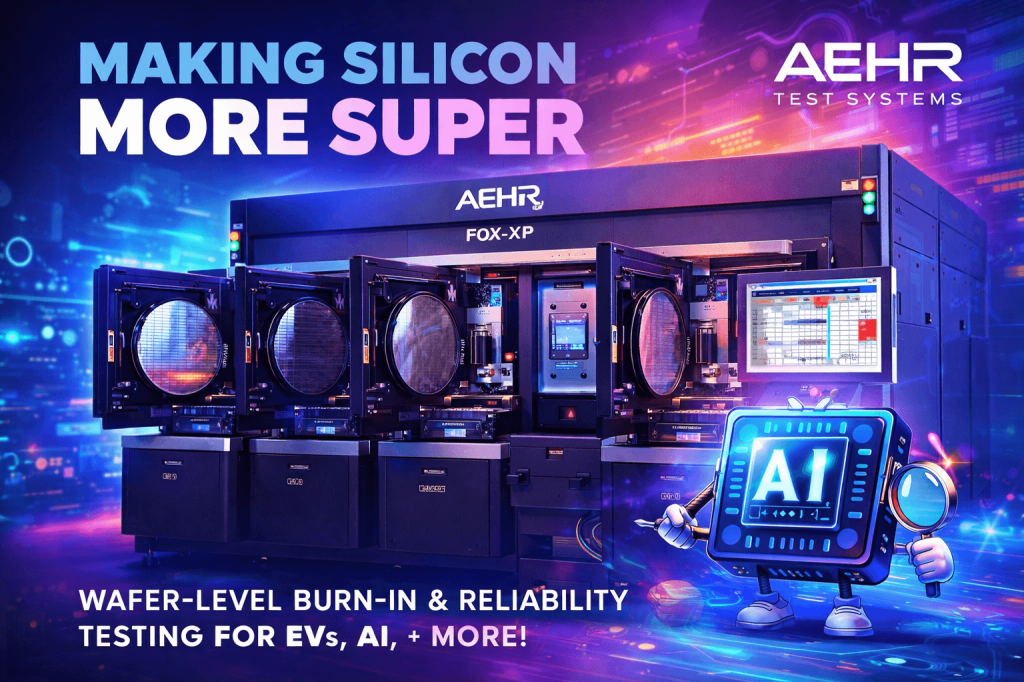
AEHR’s flagship platform is the FOX™-XP system.
What does it do?
It allows semiconductor manufacturers to perform wafer-level burn-in and test.
Let’s translate.
When a semiconductor wafer is produced, not all chips are created equal. Some will fail early. Some degrade under heat and electrical stress. Some look fine on day one and fail in the field.
That’s a disaster if your chip is inside:
- An electric vehicle inverter
- A solar inverter
- A high-voltage charging system
- An AI data center power module
Burn-in testing applies stress — heat, voltage, time — to weed out weak devices before they reach customers.
And here’s the kicker:
Silicon carbide (SiC) devices require especially rigorous testing.
SiC chips are critical for EV powertrains and high-efficiency power systems. Tesla, BYD, and other EV manufacturers rely on this technology for efficiency gains.
If SiC adoption grows…
Testing demand grows.
If AI data centers require more power management…
Testing demand grows.
AEHR sits right at that choke point.
Why It Looked Attractive in Early 2024
At the time of purchase (February 2024), several things were lining up:
1. Revenue Growth
In fiscal 2023 and heading into 2024, AEHR had posted strong year-over-year revenue growth, largely driven by silicon carbide test demand.
Growth companies with real revenue — not just “story stocks” — tend to get market attention.
2. Profitability
Unlike many speculative small-cap tech names, AEHR was:
- Generating revenue
- Posting improving margins
- Moving toward consistent profitability
This wasn’t vaporware.
3. Reasonable P/E (Relative to Hype)
In early 2024, AEHR’s P/E ratio was not absurd for a growth semiconductor equipment company — especially compared to hyper-inflated AI infrastructure names trading at nosebleed multiples.
It had growth.
It had exposure to AI infrastructure.
It had EV exposure.
But it wasn’t priced like NVIDIA.
That asymmetry was attractive.
4. AI and Power Infrastructure Narrative
Here’s what the market started realizing:
AI doesn’t just require GPUs.
It requires power.
Massive power.
And power electronics require reliable semiconductor devices.
Reliable devices require testing.
Testing requires companies like AEHR.
When the market connects those dots, multiples expand.
Why the Stock Went Up So Much
From ~$16.92 to $32.50 isn’t a meme squeeze.
It’s a re-rating.
Several forces likely drove the move:
1. Silicon Carbide Demand Acceleration
As EV production forecasts expanded, the need for SiC devices rose.
AEHR had positioned itself early as a wafer-level burn-in leader in this niche.
The market rewarded first movers.
2. AI Infrastructure Boom
Data center buildouts exploded.
Power management and reliability became front-page topics in semiconductor supply chains.
Even indirectly exposed companies benefited from the “AI halo effect.”
3. Operating Leverage
Semiconductor equipment businesses can show strong operating leverage.
When orders increase:
- Revenue rises
- Fixed costs are spread
- Margins expand
Markets love margin expansion stories.
4. Scarcity Premium
AEHR is a relatively small company in a very specialized niche.
When institutions want exposure to:
- SiC testing
- Wafer-level burn-in
- Power semiconductor validation
There aren’t 50 alternatives.
Scarcity drives volatility — in both directions.
The Business Model: Why It’s Attractive
AEHR sells:
- Testing systems (capital equipment)
- Consumables (WaferPak™ contactors)
- Service and support
This creates:
- Upfront revenue from system sales
- Recurring revenue from consumables
- Ongoing service contracts
Recurring elements are crucial.
They stabilize revenue and improve predictability.
In semiconductor equipment, the gold standard is:
Sell expensive hardware, then sell consumables forever.
AEHR fits that pattern.
Competitive Landscape
AEHR competes in a specialized segment of semiconductor test equipment.
Broader players include:
- Teradyne
- Advantest
- Cohu
But AEHR differentiates itself through:
- Wafer-level burn-in capability
- Focus on silicon carbide
- High parallelism testing
Instead of competing head-on with massive automated test equipment (ATE) giants, AEHR carved out a niche.
In investing, niches are powerful.
The Double Up Moment
Now to the fun part.
Bought:
6 shares @ $16.919
Total: $101.52
Sold:
3 shares @ $32.50
Total received: $97.50
Nearly all original capital recovered.
What remains?
3 shares.
Cost basis?
Effectively zero.
Is it life-changing money?
No.
Is it psychologically powerful?
Very.
Because now:
- Downside risk is dramatically reduced.
- Upside remains open.
- Emotionally, I can hold longer.
And long holds are where asymmetric returns live.
It Seems Like Peanuts…
Let’s be honest.
We’re not talking about 6,000 shares.
We’re talking about 6 shares.
But here’s the important thing:
Habits scale.
If the strategy works with 6 shares, it works with 60.
If it works with 60, it works with 600.
The dollar amount is irrelevant.
The process is everything.
And free shares have a funny habit of surprising you over time.
What Could the Free Shares Do?
If AEHR:
- Continues expanding in SiC testing
- Benefits from EV adoption
- Gains additional AI infrastructure exposure
- Improves margins
Those 3 shares could:
- Double again
- Triple
- Or become a long-term compounder
Or, of course, they could stagnate.
But that’s the beauty of “free.”
You can afford patience.
Final Thoughts
This wasn’t a gamble.
It was:
- A growth thesis
- Backed by industry tailwinds
- Purchased at a reasonable valuation
- Assisted by macro AI momentum
And then managed with discipline.
The market gave me back my capital.
I kept the equity.
Three small lottery tickets remain.
And who knows?
Sometimes the peanuts grow into something much bigger.
If not — at least they were free.
And free always tastes better.

 BUY, SELL, KEEP
Leave a comment