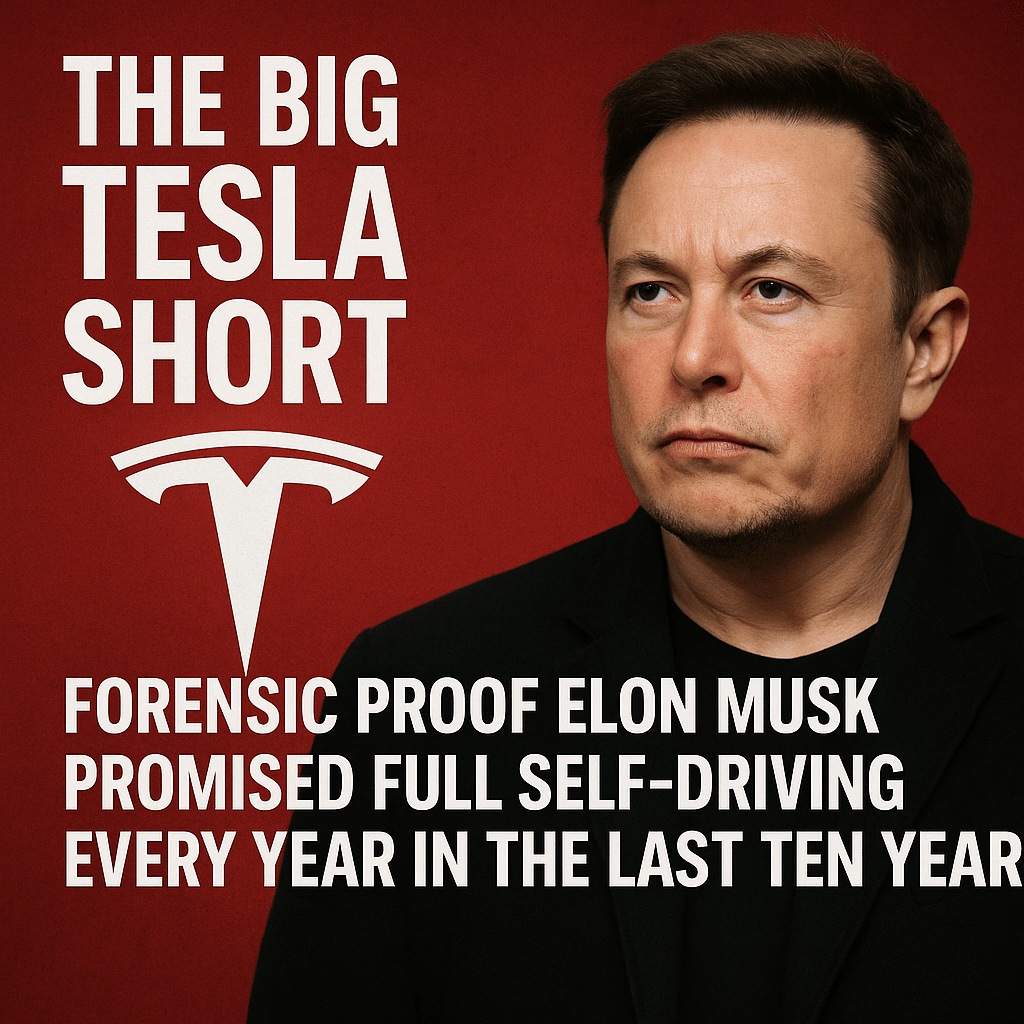
It started innocently enough.
A question.
“Is Tesla on fumes?”
What followed was not a discussion. It was a duel.
On one side: TESLA Hater — armed with margins, slowing growth charts, and LiDAR price curves.
On the other: Munsk’s Evangelist — defending the grand AI vision, data moat theory, and optionality.
And somewhere in between: reality.
Act I — The Financial Foundations
TESLA Hater:
Revenue growth is slowing. Margins are shrinking. Premium models are fading. There are effectively zero meaningful new models in the pipeline. Meanwhile Volkswagen — yes, Volkswagen — is growing faster on a percentage basis. Tesla is priced like a hyper-growth tech platform but behaving like a maturing automaker.
Munsk’s Evangelist:
Short-term numbers don’t capture platform value. Tesla isn’t just a car company. It’s an AI company wrapped in steel and batteries.
Let’s pause here.
Tesla’s revenue still overwhelmingly comes from selling cars. Not software subscriptions. Not robotaxis. Not energy storage — though that segment is growing. Cars.
And those car margins have compressed significantly due to price cuts and global competition, particularly from Chinese manufacturers.
Meanwhile, SpaceX — private, controlled, insulated from quarterly scrutiny — is widely perceived as the true profit engine in Musk’s empire, driven by:
- Starlink recurring revenue
- Government launch contracts
- Reusable rocket cost advantages
TESLA Hater’s argument sharpened:
Tesla is the only publicly exposed entity. The only one market-disciplined. The only one absorbing cyclical pressure. Meanwhile the crown jewel is private.
Munsk’s Evangelist countered:
Public scrutiny doesn’t equal weakness. It means transparency. And Tesla funds innovation across sectors.
But that opened a deeper governance question.
Is Tesla the capital base for Musk’s broader ambitions?
Or is it simply one pillar in a diversified technological ecosystem?
Act II — Autonomy: Reality vs. Vision
Then came the real battlefield: autonomy.
TESLA Hater:
Waymo runs real driverless taxis. Paying customers. No safety drivers. No beta disclaimer. No marketing demo. Real service.
And critically: Waymo uses LiDAR.
LiDAR that:
- Has dropped dramatically in cost over the last decade
- Continues to improve in resolution and reliability
- Is no longer a luxury prototype sensor
TESLA Hater pressed the scalability argument:
In three years, LiDAR units may be so cheap they’re negligible in vehicle cost structure. At that point, Tesla’s “vision-only” philosophical bet looks ideological, not economical.
Munsk’s Evangelist fired back:
More sensors ≠ better system.
Complexity scales problems. Tesla’s approach is end-to-end AI vision — scalable if cracked. Humans drive with vision. The world is designed for eyes.
TESLA Hater responded coldly:
Humans also have two eyes, depth perception, and evolutionary processing. And aviation systems rely on redundancy, not philosophy.
The core distinction emerged clearly:
| Waymo Model | Tesla Model |
|---|---|
| Geofenced cities | Global ambition |
| Sensor redundancy | Vision-only |
| Controlled fleet | Distributed fleet |
| Operational today | Aspirational at scale |
Waymo is building a service.
Tesla is building a theory.
Act III — Scalability and Industrial Strategy
TESLA Hater pushed further:
Waymo can partner with manufacturers capable of producing vehicles at scale. Capital efficient. Asset-light in comparison.
Tesla must:
- Build factories
- Manage supply chains
- Compete in brutal global EV markets
- Refresh product lines
And here the uncomfortable truth surfaced:
Tesla’s model lineup has stagnated.
- Model S/X marginalized.
- Model 3/Y aging.
- No true mass-market next-gen platform yet deployed.
- Cybertruck polarizing, not volume-defining.
In automotive terms, that’s dangerous.
In tech valuation terms, it’s lethal.
Munsk’s Evangelist returned to the moat:
Millions of Teslas collecting real-world driving data. That dataset advantage compounds daily.
TESLA Hater cut back:
Data without proven full autonomy is just stored footage.
Act IV — The Valuation Question
This is where markets matter.
Tesla is priced as:
- An EV leader
- An AI software company
- A robotics platform
- A future robotaxi network
- A possible energy grid disruptor
That’s multiple embedded optionalities.
But optionality only works if at least one option materializes.
If Tesla remains primarily a car manufacturer in a hyper-competitive global market, valuation compression becomes rational.
If robotaxi autonomy arrives at scale, everything changes.
The market isn’t pricing today.
It’s pricing a future state.
TESLA Hater’s thesis:
The probability-weighted outcome does not justify the current premium.
Munsk’s Evangelist’s thesis:
Transformational companies always look overvalued before inflection.
Act V — The Referee Enters
At this point, emotion had overtaken rhetoric.
So the referee reviewed the evidence:
- Growth slowing.
- Margins compressed.
- Product refresh limited.
- Autonomy unproven at true driverless scale.
- Competitor operating today.
- SpaceX privately thriving.
- Tesla publicly pressured.
The referee acknowledged:
Tesla has optionality.
Tesla has brand power.
Tesla has data scale.
But:
Optionality is not execution.
And execution defines valuation sustainability.
The Verdict
Round awarded to: TESLA Hater
But this wasn’t symbolic.
The gavel translated into action.
Trade Executed
| Symbol | Quantity | Unit Cost | Total Cost |
|---|---|---|---|
| TSLA | -100 | 420.52 | -42,052.00 |
Position: Short 100 shares of TSLA
Execution Price: $420.52
Total Exposure: $42,052
Not commentary.
Not vibes.
Not tweets.
Execution.
Munsk’s Evangelist objected.
Markets do not reward certainty.
But they also do not reward denial.
The Bigger Picture
This debate isn’t about disliking Tesla.
It’s about asking:
- Is Tesla transitioning into a software-margin AI platform?
- Or is it maturing into a cyclical automaker with tech branding?
- Will autonomy be a city-by-city service (Waymo model)?
- Or a universal embedded AI layer (Tesla model)?
One model works today.
The other could be bigger tomorrow.
But “could” doesn’t support multiples indefinitely.
Final Thought
If autonomy scales globally through vision AI, this short will age badly.
If autonomy remains structured, sensor-heavy, and regulated city by city, Tesla’s valuation will face gravity.
The position is live.
The thesis is public.
The duel is over.
The market now writes the ending.

 BUY, SELL, KEEP
Leave a comment